

| Case Series Online Published: 27 Apr 2025 | ||||||||||||||||||||||||||||||
Case Rep Ser Med. 2025; 2(1): 17-20 Sudden sensorineural hearing loss; analysis of 12 cases seen and managed in a Tertiary Heath care institution in Sokoto, Nigeria Sufiyanu Yabo Umar, Kufre Robert Iseh.
| ||||||||||||||||||||||||||||||



Introduction
Sudden sensorineural hearing loss (SSNHL) is an ear, nose and throat (ENT) emergency characterized by sudden 30-dB sensorineural hearing loss in at least 3 contiguous frequencies occurring over a 72-hour period.SSNHL often affects healthy individuals and is a frightening symptom that prompts individuals to seek urgent medical attention [1].SSNHL is usually unilateral and can be associated with tinnitus and vertigo. In most cases, the cause is not identified, although various infective, vascular, and immune causes have been proposed. A careful examination is needed to exclude life-threatening or treatable causes such as vascular events and malignant diseases, and patients should be referred urgently for further assessment [2]. About half of patients completely recover, usually in about 2 weeks. Many treatment modalities are used, including corticosteroids, antiviral drugs, and vasoactive and oxygen-based treatments [3].SSNHL affects 5–27 per 100,000 people annually, with about 66,000 new cases per year in the United States [1]. Although prevalence studies do not necessarily distinguish between idiopathic and acquired sensorineural hearing loss, most cases of spontaneous SHL have no identifiable cause [4].
A cause of SSNHL can be found only in 10%–15% of patients, and when no cause is identified, SSNHL is “Idiopathic” [5,6].A number of infectious diseases can be associated directly with SSNHL, including meningococcal meningitis, herpes virus, Mumps, AIDS, Mononucleosis, Lassa fever, Mycoplasmosis, and Syphilis. Traumatic causes include perilymph fistula, inner ear decompression sickness, temporal bone fracture, inner ear concussion, and otologic surgery [7–9]. Usually, proper history and adequate examinations are diagnostic. Neoplastic causes of SSNHL are vestibular schwannoma, leukaemia, myeloma, meningeal carcinomas, and metastasis to the internal auditory canal. Other causes of SSNHL include; primary autoimmune inner ear disease, Wegener’s granulomatosis, Cogan syndrome, temporal arteritis, ototoxicity, snake bite, multiple sclerosis, thyrotoxic hypokalemia, Meniere’s disease and syndromes, neurosarcoidosis, and pseudohyperacusis [10–13].
Patients and Methods
A total of 12 patients diagnosed with SSNHL and managed at the ENT Department of Usmanu Danfodiyo University Teaching Hospital Sokoto from September 2015 to September 2024, were included. All patients received the same treatment during hospitalization and received appropriate follow-up care post-hospitalization. All patients underwent physical examination of the eardrum and cranial nerves, hearing ability tests (pure tone audiometry), and temporal CT scans. Cases with inflammation in the middle or inner ear were excluded. Hearing tests were conducted using the following schedule; at the time of admission, daily during the time of hospitalization after the treatment began, once a week for the first month after being discharged from the hospital, and once a month thereafter.The diagnostic criterion for SSNHL was more than 30-decibel hearing loss (dB HL) in three consecutive frequencies within 3 days of symptom onset. All patients diagnosed with SSNHL received absolute rest and a low-salt diet for 7 days. Medical therapy, parenteral dexamethasone was given during the period of hospitalization, at discharge, steroid therapy was converted into oral prednisolone. In addition, antioxidants (vitamin A, E, and C) were administered as a supplements. Parenteral dexamethasone was given at 0.5 mg/kg/day, divided into 3 doses (given every 8 hours), vitamin C: 200 mg every 8 hours, and vitamin A: 300 mcg (10,000 U) daily while vitamin E: 400 units twice daily.
The degree of hearing loss was measured using the average threshold value dB HL, which was derived from the method of quartering of 0.5, 1, 2, and 3 kHz using pure-tone audiometry [9]. Hearing loss was classified as mild (26–40 dB), moderate (41–55 dB), moderately severe (56–70 dB), severe (71–90 dB), or profound (≥91 dB) [9]. The hearing threshold value was used as a criterion according to Shaia and Sheehy [3]. Thus, the pure-tone audiograms were classified as follows: rising (lower threshold values in the high-frequency range of 2000–4000 Hz than in the low-frequency range of 250–500 Hz), flat (similar threshold observed across the entire frequency range), and sloping (higher threshold values in the high-frequency range than in the low-frequency range) [3,10]. Cases were classified as profound when hearing loss was profound and classification was not possible.Patient’s degree of recovery was classified into four groups according to Siegel’s method of classification [11]; complete recovery, partial recovery, slight recovery, and non-recovery. The complete recovery group included patients with final hearing abilities <25-dB HL. The partial recovery group included patients with hearing recovery >15-dB HL with final hearing abilities between 25- and 45-dB HL. The slight recovery group included patients with hearing recovery of >15-dB HL with final hearing abilities >45-dB HL. The non-recovery group included patients with hearing recovery <15-dB HL with final hearing abilities >75-dB HL.The chi-squared test and logistic regression analyses were conducted using SPSS for Windows 25.0 (SPSS Inc., Chicago, IL, USA). Results were considered significant when the p-value was below 0.05.
Results
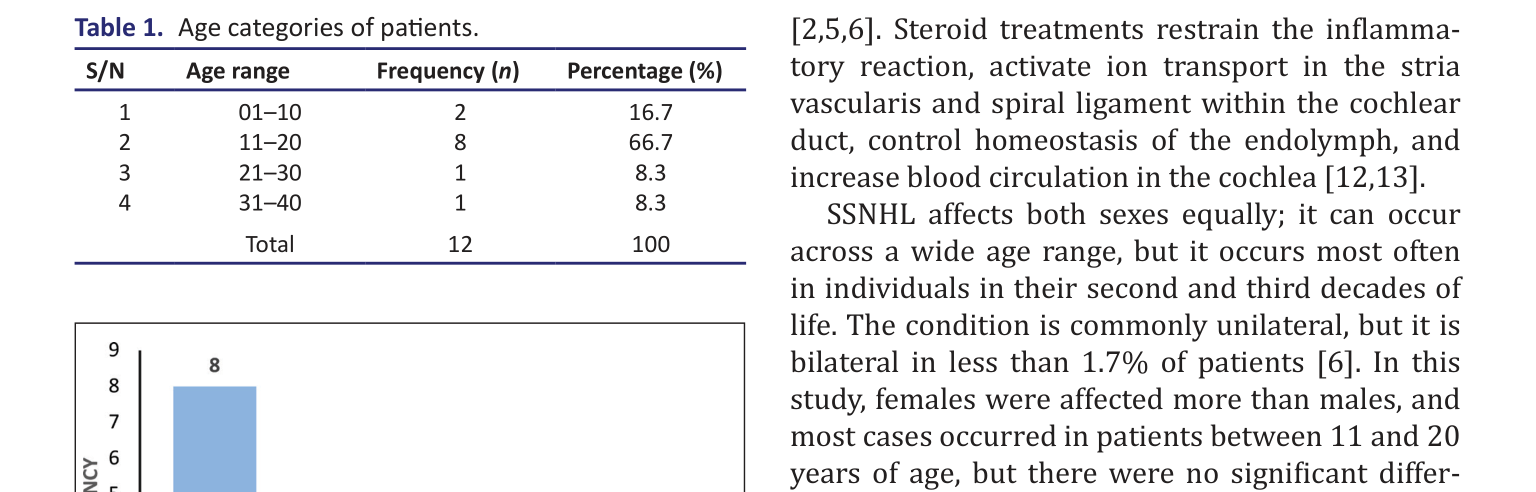
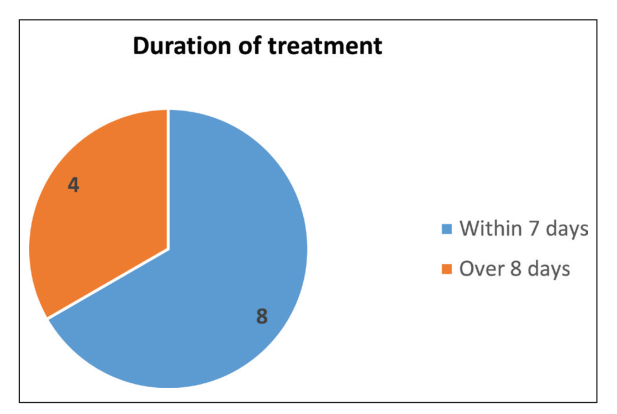
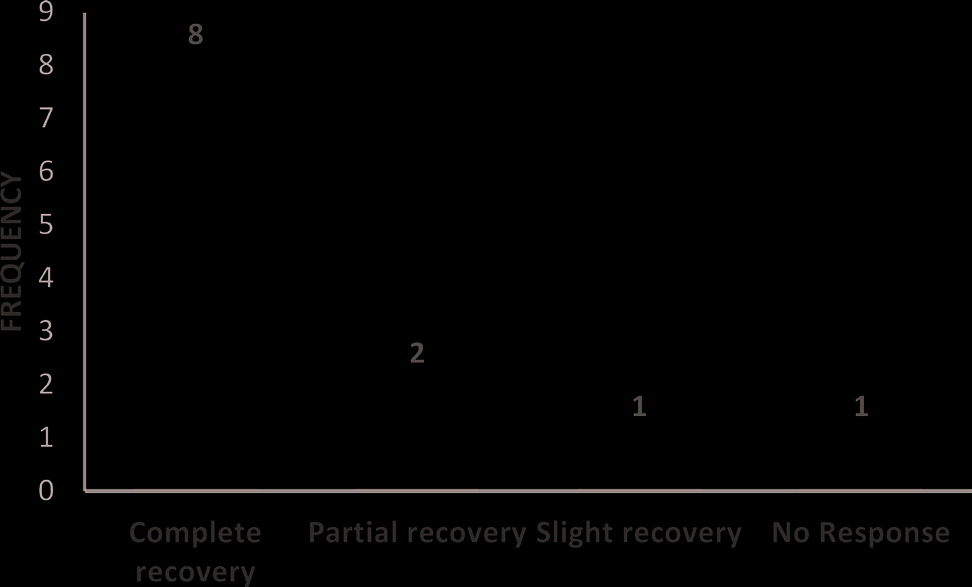
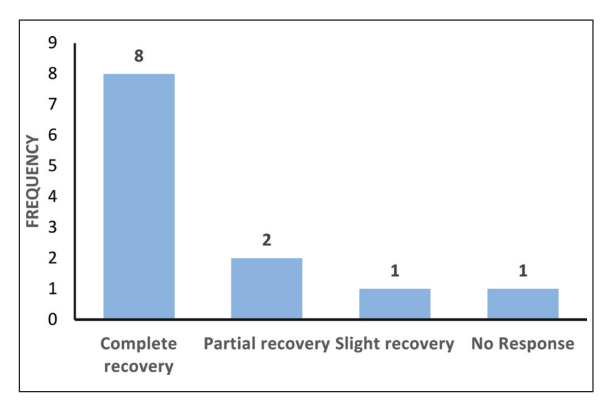
Age 11–20 years were commonly affected (Table 1). Females 8 (66.7%) and males 4 (33.3%) with a male-to-female ratio of 1:2. All the patients presented with profound SSNHL. 10 of the 12 patients presented within the first 24 hours of onset and the remaining 2 patients presented within 72 hours of onset. Hearing improvement was observed in 7 of 12 (58.4%) of patients within the first 3 to 4 days of treatment followed by rapid hearing recovery. 8 out of 12 patients had complete recovery (66.7%), 2 patients had partial recovery (16.7%), 1 patient had slight recovery (8.3%) and 1 patient had no response (Fig. 1). 8 of the 12 patients were treated within 7 days and 4 patients were treated for over 8 days (Fig. 2). All the patients were treated with parental and oral steroids, and antioxidants.
Discussion
SSNHL is a sensorineural hearing loss that occurs suddenly within hours or days with no clear cause. SSNHL is diagnosed in patients with a sensorineural hearing loss of >30 dB in three or more consecutive frequencies occurring within 3 days. Causes of SSNHL include viral infection, blood vessel disorder, inner ear membrane rupture, and autoimmune disease [12]. SSNHL is managed using a variety of treatments including high-concentration steroid injection for anti-inflammation or vasodilation [2,5,6]. Steroid treatments restrain the inflammatory reaction, activate ion transport in the stria vascularis and spiral ligament within the cochlear duct, control homeostasis of the endolymph, and increase blood circulation in the cochlea [12,13].SSNHL affects both sexes equally; it can occur across a wide age range, but it occurs most often in individuals in their second and third decades of life. The condition is commonly unilateral, but it is bilateral in less than 1.7% of patients [6]. In this study, females were affected more than males, and most cases occurred in patients between 11 and 20 years of age, but there were no significant differences between the sexes. All the patients from this study had bilateral cases of SSNHL, some literatures reported unilateral cases of SSNHL as commoner than bilateral disease [1,2,3].Steroids (both oral and parenteral) were used as the drug of treatment in all our patients and with good hearing recovery outcomes. Chandrasekhar et al. [1] reported steroids to have statistically significant effects on the recovery of hearing among patients with moderate SSNHL, Neil et al. [10] reported that a high dose of oral prednisolone may improve hearing outcomes particularly if started early.
Conclusion
SSNHL is a usual complaint in audiologic and otolaryngologic practice. Even though most cases of SSNHL are idiopathic, a significant number of treatable conditions can underlie SSNHL. Efforts to detect these conditions should be part of the diagnostic workup. The prognosis for hearing recovery is based on several factors, including duration and degree of deafness, and age of the patients. In spite of the fact that SSNHL will often resolve spontaneously even without treatment, directed therapy against identifiable causes of SSNHL and corticosteroid therapy for idiopathic SSNHL appear to be the mainstay treatment options for these patients.
Conflict of interest
The authors declared no conflict of interest.
Funding
No funding was received for this study.
References1. Chandrasekhar SS, Tsai Do BS, Schwartz SR, Bontempo LJ, Faucett EA, Finestone SA, et al. Clinical practice guideline: sudden hearing loss (Update).
Otolaryngol Head Neck Surg 2019; Vol 161 (IS):S1–S45; doi: 10.1177/0194599819859885 2. Conlin AE, Parnes LS. Treatment of sudden sensorineural hearing loss: I. A systematic review. Arch Otolaryngol Head Neck Surg 2007; 133:573–81.3. Mukherjea D, Rybak LP. Pharmacogenomics of cisplatin-induced ototoxicity. Pharmacogenomics 2011; 12:1039–50. 4. Doyle PJ, Anderson DW, Pijl S. The tuning fork: an essential instrument in otologic practice. J Otolaryngol 1984; 13:83–86. 5. Haynes DS, O’Malley M, Cohen S, Watford K, Labadie RF. Intratympanic dexamethasone for sudden sensorineural hearing loss after failure of systemic therapy. Laryngoscope. 2007; 117:3–15; doi: 10.1097/01.mlg.0000245058.11866.156. Pirozzo S, Papinczak T, Glasziou P. Whispered voice test for screening for hearing impairment in adults and children: systematic review. BMJ 2003; 327:967.7. Ibrahim FW, Malu MK. Sudden deafness in a patient with secondary syphilis. J Laryngol Otol 2009; 123:1262–65.
8. Wiles NM, Hunt BJ, Callanan V, Chevretton EB. Sudden sensorineural hearing loss and antiphospholipid syndrome. Haematologica 2006; 91(12 Suppl):ECR46. 9. Gordon BH, Michael AF, Thomas JH, Marc EG. Sudden sensorineural hearing loss. Otolaryngol Clin North Am 1996: 29(3):393–405.10. Neil F, Nishchay M, Joseph T. Sudden sensorineural hearing loss, causes, investigations, and management. Aus Fam Physician 2013; 42(9):1–6. 11. Kuhn M, Heman Ackah SE, Shaikh JA, Roehm P. Sudden sensorineural hearing loss: a review of diagnosis, treatments and prognosis. Trends Amplification 2011; 15(3):91–105; doi: 1177/108471381140834912. Farrawel RW, Pemberton MN, Parker AJ, Buffin JT. Sudden deafness after dental surgery. BMJ 1991; 303:1034–41. 13. Kamzaki J. Idiopathic sudden progressive hearing loss and round window rupture. Arch Otorhinolaryngol 1986; 243:158–61.
| How to Cite this Article |
| Pubmed Style Umar SY, Iseh KR. Sudden sensorineural hearing loss; analysis of 12 cases seen and managed in a Tertiary Heath care institution in Sokoto, Nigeria. Case Rep Ser Med. 2025; 2(1): 17-20. doi:10.5455/CRSM.20250204074315 Web Style Umar SY, Iseh KR. Sudden sensorineural hearing loss; analysis of 12 cases seen and managed in a Tertiary Heath care institution in Sokoto, Nigeria. https://www.wisdomgale.com/crsm/?mno=302657817 [Access: June 27, 2026]. doi:10.5455/CRSM.20250204074315 AMA (American Medical Association) Style Umar SY, Iseh KR. Sudden sensorineural hearing loss; analysis of 12 cases seen and managed in a Tertiary Heath care institution in Sokoto, Nigeria. Case Rep Ser Med. 2025; 2(1): 17-20. doi:10.5455/CRSM.20250204074315 Vancouver/ICMJE Style Umar SY, Iseh KR. Sudden sensorineural hearing loss; analysis of 12 cases seen and managed in a Tertiary Heath care institution in Sokoto, Nigeria. Case Rep Ser Med. (2025), [cited June 27, 2026]; 2(1): 17-20. doi:10.5455/CRSM.20250204074315 Harvard Style Umar, S. Y. & Iseh, . K. R. (2025) Sudden sensorineural hearing loss; analysis of 12 cases seen and managed in a Tertiary Heath care institution in Sokoto, Nigeria. Case Rep Ser Med, 2 (1), 17-20. doi:10.5455/CRSM.20250204074315 Turabian Style Umar, Sufiyanu Yabo, and Kufre Robert Iseh. 2025. Sudden sensorineural hearing loss; analysis of 12 cases seen and managed in a Tertiary Heath care institution in Sokoto, Nigeria. Case Reports and Series in Medicine, 2 (1), 17-20. doi:10.5455/CRSM.20250204074315 Chicago Style Umar, Sufiyanu Yabo, and Kufre Robert Iseh. "Sudden sensorineural hearing loss; analysis of 12 cases seen and managed in a Tertiary Heath care institution in Sokoto, Nigeria." Case Reports and Series in Medicine 2 (2025), 17-20. doi:10.5455/CRSM.20250204074315 MLA (The Modern Language Association) Style Umar, Sufiyanu Yabo, and Kufre Robert Iseh. "Sudden sensorineural hearing loss; analysis of 12 cases seen and managed in a Tertiary Heath care institution in Sokoto, Nigeria." Case Reports and Series in Medicine 2.1 (2025), 17-20. Print. doi:10.5455/CRSM.20250204074315 APA (American Psychological Association) Style Umar, S. Y. & Iseh, . K. R. (2025) Sudden sensorineural hearing loss; analysis of 12 cases seen and managed in a Tertiary Heath care institution in Sokoto, Nigeria. Case Reports and Series in Medicine, 2 (1), 17-20. doi:10.5455/CRSM.20250204074315 |